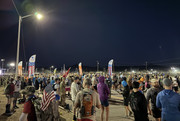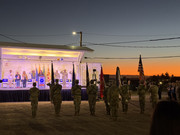
Some of the soldiers and airmen took on an additional challenge with the light, medium and heavy pack divisions. At the end of the race, I saw many packs weighing 40 pounds or more. One soldier carried 66 pounds. Most of the weight was rice and beans the soldiers stuffed into their packs to be donated to the local food bank. I can't tell you how humbling and inspiring it was to see the relief on the faces of these exhausted young men and women as they climbed out of those packs at the weigh station, their backs soaked with sweat and in at least one case, blood. The water I handed out was instantly accepted with a gasping "Thank you sir."
This was the 37th annual Bataan Memorial March at White Sands. Why here, in New Mexico?
As the Army was preparing to reinforce our positions in the Philippines in anticipation of Japanese aggression, war planners lit upon New Mexico's 200th Coast Artillery, 1,816 men strong and half of whom spoke Spanish. Thinking it an excellent match, the War Department ordered the 200th to the Bataan Peninsula, which was well-situated to defend Manila Bay. The Japanese landed just before Christmas in 1941, and despite heroic defensive engagement by American and Filipino forces, the invaders forced our men -- including the 200th -- to surrender on April 9. Then began that 62-mile march.
When the 200th was activated, New Mexico had a population of just more than 500,000. Of the 1,816 boys from the Land of Enchantment, the regiment lost more than 800 in the march and subsequent imprisonment. Of the roughly 1,000 who made it home, one third were dead within the year from the effects of injuries and malnutrition they had endured in Japanese captivity. When you do the math, Bataan took an outsized toll on New Mexico's sons, and that's why you see so many roads, highways and memorials to the Death March survivors down here.